
analysis-video
Open-source CLI that turns video into AI-readable context.
- Stack
- Python 3.11–3.14 · uv workspace · PyAV · NumPy · scikit-image · PySceneDetect · PySide6 · MLX / faster-whisper · GitHub Actions
Ask an AI to analyze a lecture video and all it gets is the subtitles: the speech, and nothing that was written, drawn, coded, or shown on screen. analysis-video puts the missing half back.
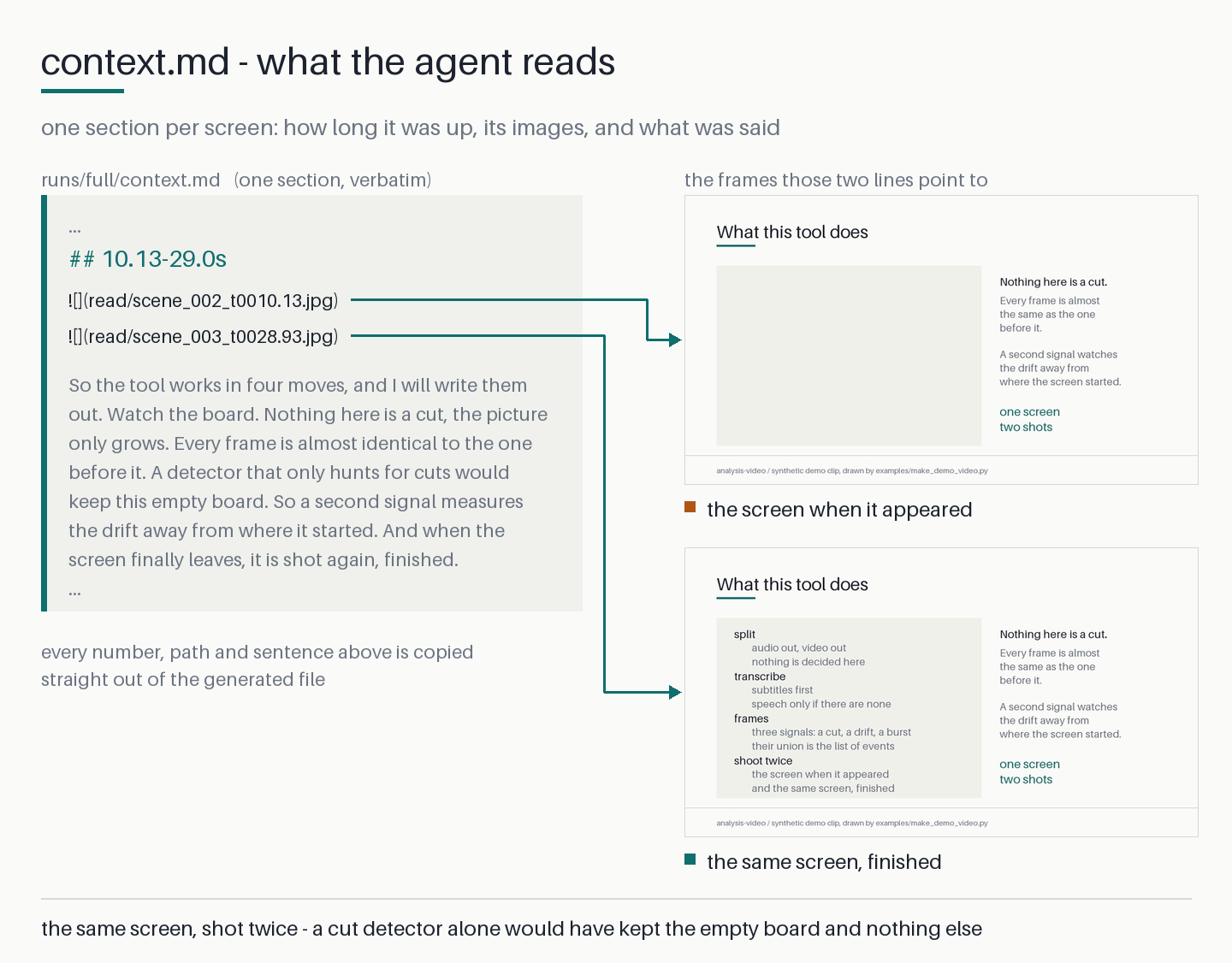
A command-line tool that turns lecture, screencast, and slide-based video into a single Markdown file an LLM can read: one section per distinct on-screen state, with its keyframe images, the seconds it stayed on screen, and the dialogue spoken over it. Runs entirely on the user’s machine: no API key, no upload, no ffmpeg install.
Role: sole designer and developer — algorithm, CLI contract, packaging, docs, release.
What I built
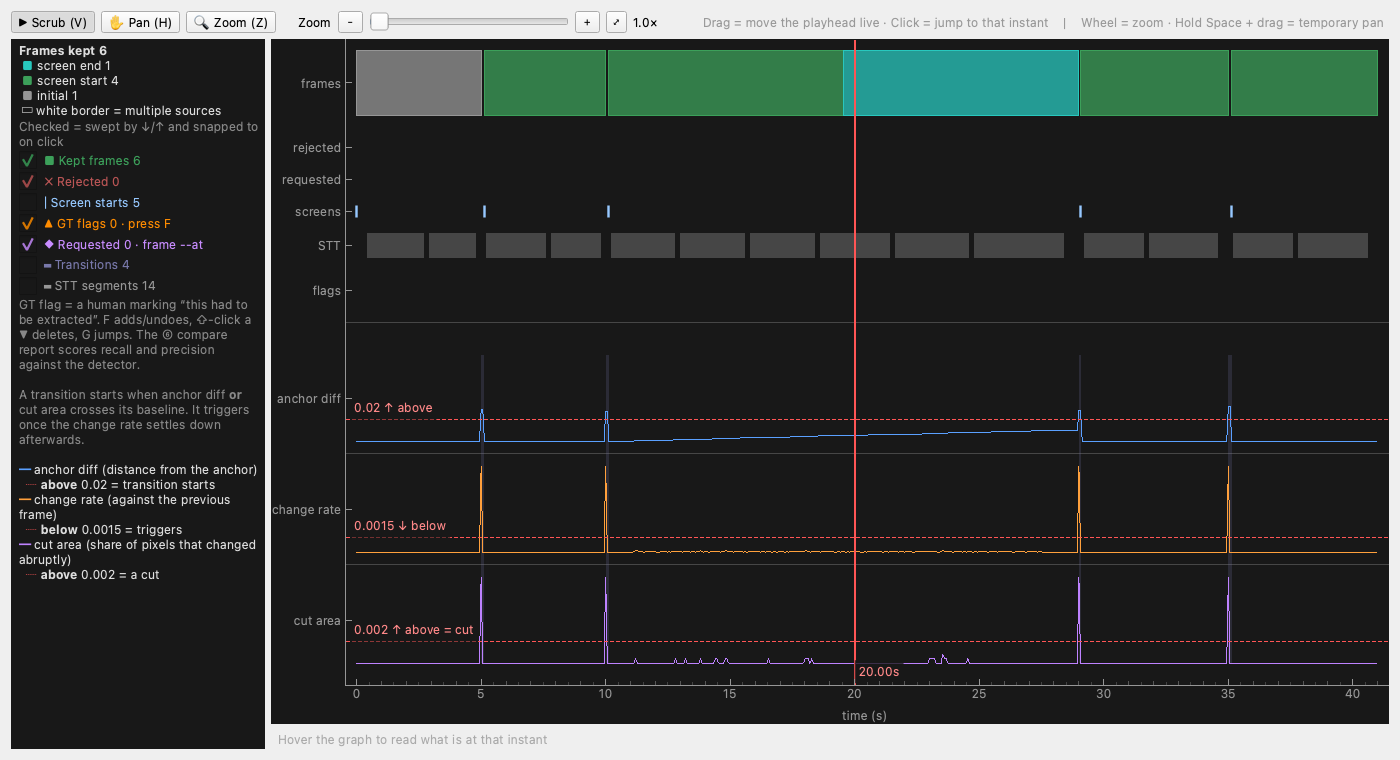
- Change-driven frame selection. Frames are chosen by how much the screen changed (three pixel-domain signals against rolling baselines), not at a fixed interval. Progressive content such as a board being written keeps both the empty and the finished state — a cut detector alone keeps only the empty one.
- Agent-first CLI contract. One JSON object on stdout, decisions expressible through exit codes alone, absolute paths, resumable stages, and a
nextobject quoting the image-token bill before any image is opened. - Context-window economics. Linked images are downscaled reading copies, measured at 4.17x fewer tokens than the full-resolution frames kept alongside.
- Durable analysis. The agent’s write-up is stored and stamped with the sha256 of the exact input it read, so re-detection marks it stale instead of letting an outdated reading pass as current.
- Zero-LLM pipeline. Subtitles are read as written, speech recognition is Whisper, frame detection is pixel math. Interpretation stays with the calling agent.
- Optional Qt desktop GUI that scores detector output against ground truth.
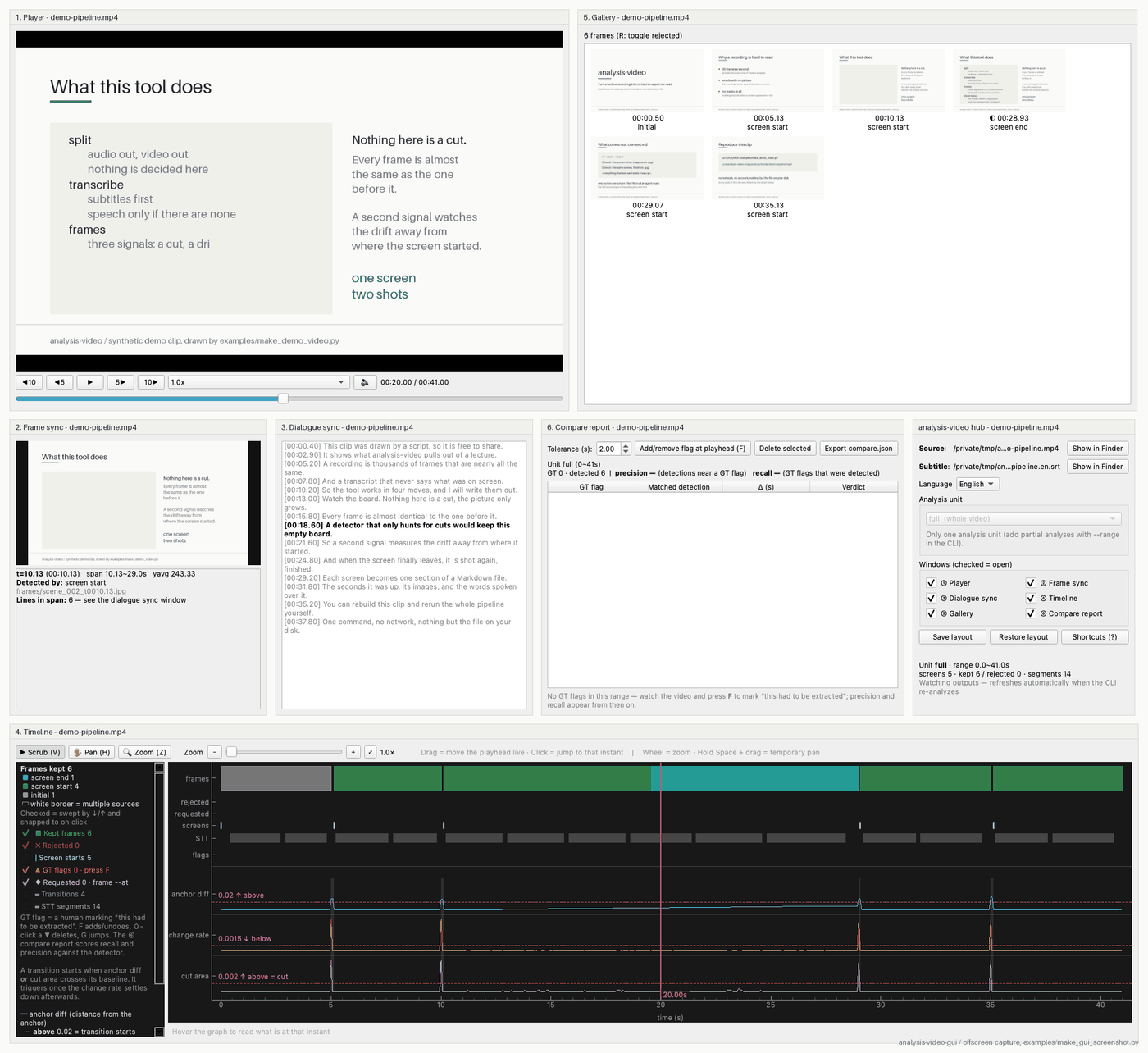
Published as two packages — analysis-video and analysis-video-gui — under MIT.
댓글